Showing posts with label humidity. Show all posts

Thursday, December 28, 2017

Clock 3 cased and installed

Clock 3 is finally complete, and is now installed in an oak frame/case in my office.  The case has a matching French cleat so the movement is easy to remove for debugging.  I also installed a dial that is perched on pins on the shelf, which allows it to be easily removed by lifting it off the movement. 


It is now driven by a 10 pound bag of lead pellets (intended for scuba diving) with a two-fall pulley.  It runs for 16 hours on a wind.  This short run time is well enough so that it shouldn't bother my office neighbors.  It's a bit noisy, but now that it is no longer mounted on a hollow cavity, it's quieter than before.

Moving the clock from my cool, damp basement to the warm, dry office did require some adjustments...  The movement's frame has the grain going horizontally, which meant that it shrank vertically a bit.  This caused the impulse pin to bind on two things:
1. The detent tip, which required shifting the detent back slightly
2. The trailing edge of one escape wheel tooth, which required a small amount of filing.

The great wheel also fouled on the frame -- an indication that my "fancy" milled frame wasn't a good idea -- since it appears that the frame has shrunk vertically.  To compensate, I carved the milling back further.

The great wheel pivot, which I had previously needed to move (and I wondered why!) had to be set back in its original position as well.

Additionally, many friction-fit parts loosened and required the use of super glue to anchor:
1. The impulse pin
2. The hour finger
3. The dial pins 

Wooden hygrometer

Based on the issues of wood expansion with my clocks, a natural project would seem to be a wooden hygrometer.  At least, it ought to respond about as fast as the wood in the clocks responds, which appears to be around a few days. 


The design is fairly simple, with two oak sticks of roughly the same length being placed parallel to each other and rigidly anchored at one end.  One of the strips has the grain running lengthwise, while the other has the grain running perpendicular to that.  The two free ends are pinned to a needle.  I placed the parallel-grain strip on the bottom, so that the needle moves to the right as the humidity increases.  With this particular item, fully soaking it for a week in water runs the needle all the way to the right of the scale.


But the typical indoor humidity is closer to the first picture.  The needle usually moves around 1/4"-1/2" with daily variations.

Thursday, August 17, 2017

Clock 1 humidity redux

I think I have finally figured out what goes wrong with Clock 1 when the humidity changes.  After much watching and poking, I found that the third wheel appeared to be sticking slightly, at least whenever the clock stopped.  Carefully pulling the third wheel backwards once the clock stopped, I could feel some rubbing...

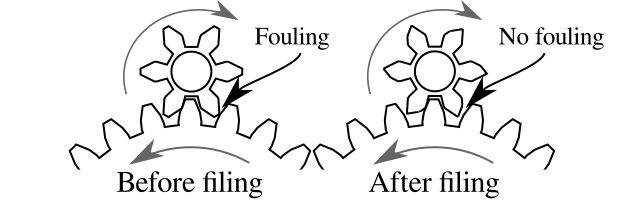
I think the third wheel pinion expanded a bit beyond where it was supposed to, or maybe the frame expanded, but in any event, it was fouling at the tip.  After ensuring that the pivot was rigidly planted where it was supposed to be, I took to very slightly filing the addenda of the pinion.

This makes the pinions closer to an ogive form.  I don't think this really matters, because the clock is now happily running even though the humidity has been around 60%.  Hopefully I won't run into an "opposite" problem when the humidity drops later in the year.

Monday, May 29, 2017

Clock #1 summertime adjustments...

Clock #1 has been in our dining room since I moved it upstairs since March 11.  It ran for several months, and then in mid-April started to become unreliable.  I suspected weather factors were the cause.  After running from mid-April until mid-May, it stopped again, this time apparently for good.  After letting it sit for about 10 days, I went back to investigate the issue.

The overall friction appears to be higher in the spring/summer (though I don't know for certain), although it's unclear exactly if this is localized to a specific mesh in the train..

It seems that the problem was that a few escape teeth were too long by a very small amount (8/1000").  When the friction is lower in the train, the pendulum amplitude is high enough that this doesn't matter.  But when the amplitude drops, this becomes a problem.

To debug the problem, I stuck a post-it note to the back of the frame behind the pendulum.  I marked on this paper the precise pendulum location when each escape tooth released.   The marks were about 13" from the pendulum pivot, and indicate that the typical distance between entry and exit release was 3/16", or about 0.8 degrees peak-to-peak.  So if the pendulum swings less than that, the clock is likely to stop.  I found that one tooth that seemed to cause stoppage consistently corresponded to a mark 1/16" farther out from the rest.  This means that an additional 0.15 degrees was necessary to escape that tooth.  Since the anchor has a length of 1 3/4", this translates to an escape tooth of about (1/16)*(7/4)/13 = 8/1000" longer than the rest.  That's a very small amount, but easily corrected with a file.  Once I corrected that, I checked each other tooth as well, adjusting them so they were all within the 0.4 degree peak-to-peak release margin. 

It seems unlikely that expansion or contraction of the escapement itself (due to weather) is the cause of the clock's malaise, especially because that particular tooth was already marked as being problematic in the past!  Hopefully, my guess about balance amplitude is correct, because it seems to also explain the other issues about the escape wheel sitting at the front/back of the clock too.  This slightly shifts the escape wheel up/down by a very small amount and seems to change the effective length of the escape wheel teeth by a few thousandths of an inch.

Tuesday, May 19, 2015

Humidity and wooden clocks

Wood changes size and shape with temperature and humidity.  Even small changes in shape can disrupt the workings of gears.  Therefore -- and this actually is starting to happen as the summer arrives -- wooden clocks can stop working when the weather changes.  I've had to restart my clock a few times over the past month on particularly warm and humid days.

[Edit: It seems like humidity higher than 75% stops the clock and it won't restart.  Below around 50% seems to let the clock run reliably.]